


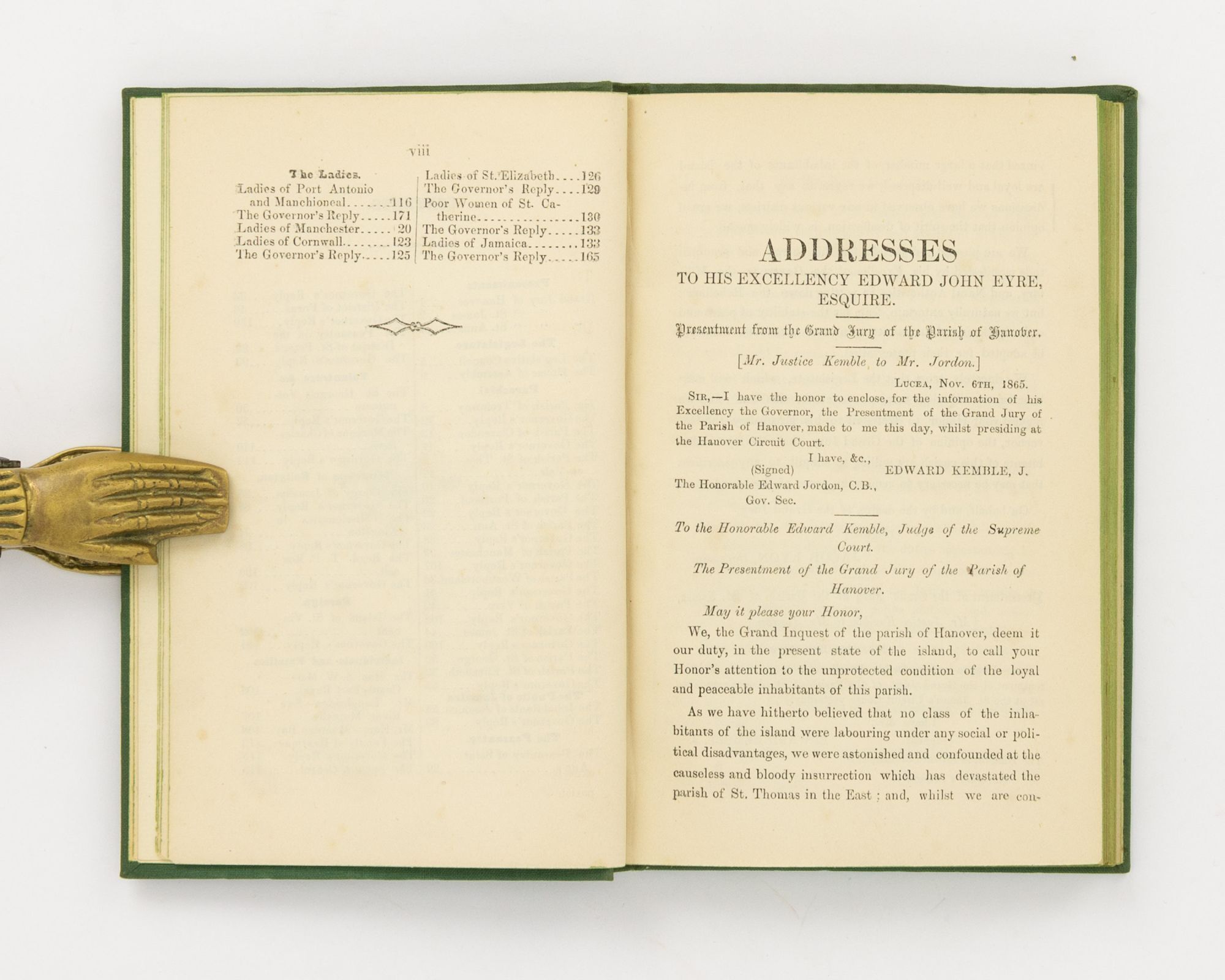


Jamaica. Addresses to His Excellency Edward John Eyre, Esquire, &c., &c., 1865, 1866
[Kingston, Jamaica], M. DeCordova & Co., Printers, 1866.
Octavo, viii (first leaf blank), 172 pages.
Early light green binder's cloth lettered in gilt on the spine 'Edward John Eyre'; spine lightly sunned; marginal emphases in ink by Eyre himself on 35 pages; a fine copy.
Edward John Eyre (1815-1901) is best remembered in Australia for his epic year-long journey in 1840-41 from Adelaide to Albany, which only he and his Indigenous companion Wylie survived. He then served as Protector of Aborigines in South Australia until 1844, lieutenant-governor of New Zealand, 1846-53, and governor of St Vincent, 1854-60. 'In 1861 he became acting governor of Jamaica, and in 1864 he was appointed governor-in-chief. For three years in the vicious political atmosphere of Jamaica Eyre had had only temporary authority, but despite unpopularity he was not a bad governor; then, on 11 October 1865, he was faced with a serious riot at Morant Bay. Interpreting this as the first step in a general rebellion, Eyre declared martial law in the county of Surrey, except for Kingston, and the armed forces began an orgy of reprisals which by the end of martial law on 13 November had led to the killing or executing of 608 persons, the flogging of 600, and the burning of 1000 dwellings.... Eyre was hailed as a saviour in Jamaica but speedily denounced as a murderer and a monster of cruelty in England. A royal commission found that Eyre had acted with commendable promptitude but unnecessary rigour. He was relieved of his governorship and recalled to England, where he became the centre of intellectual warfare between the Jamaica Committee supported by J.S. Mill, Thomas Huxley, Thomas Hughes, Herbert Spencer and others and the Eyre Defence Committee supported by Carlyle, Charles Kingsley, Tennyson, Ruskin and others. Proceedings were brought against Eyre three times, but each time dismissed; Eyre's interpretation of martial law has become a celebrated case in legal history. In a public speech at Bow Street Eyre defended himself in a very dignified account of his actions, but otherwise, until his death, he maintained a stoical silence. The poignant contrast remains between the friend of Wylie and humane protector of the Aboriginals in Australia, and "the monster of Jamaica". The obstinacy that gave him his endurance as an explorer was his undoing as a governor in Jamaica; yet he had been a successful governor in Antigua and the Leeward Islands. Perhaps the key to Eyre's later actions may lie in those unhappy years in New Zealand when Grey overrode his authority and undermined his confidence. In 1872 the British government ordered payment of Eyre's legal expenses, and in 1874 Disraeli's ministry gave him a pension as a retired colonial governor. He retired to Walreddon Manor, near Tavistock, where he lived in seclusion until his death on 30 November 1901' ('Australian Dictionary of Biography'). Bound in at the front of the book is an autograph letter signed by Eyre (4 pages small octavo, slightly trimmed but not cropped, with the letterhead 'Walreddon Manor, Tavistock, Devon' printed in red). It is dated 25 October 1901 and was sent with the book to Arthur Mee (1875-1943, English journalist, writer and educator) after the appearance of an article on the rebellion in the recent issue of the magazine 'Black and White'. Eyre thanks Mee for the generous way he made use of his earlier letter of 26 September, 'practically saying ... to your readers "Audi alteram partem"'. The passages marked by Eyre in this copy of the book ('these documents so personal to myself') are testimonials supportive of his actions in putting down the rebellion. 'The public incident being now closed I should wish you personally to know what the views and feelings of the colonists were.' Eyre died little more than a month after writing the letter, on 30 November 1901, aged 86.
Item #140718
Price (AUD):
$5,000.00